![[Seoul Forum 2026] Before K-Pop, There Was K-Culture #1 > Blog](/img/assets/symbol.svg)
Blog
[Seoul Forum 2026] Before K-Pop, There Was K-Culture #1

National Museum of Korea Director Yoo Hong-jun on the Centuries of Art, Exchange, and Identity Behind Korea’s Global Cultural Rise
When people around the world think of Korean culture today, they may think first of K-pop, Korean dramas, films, beauty, or food.
But the story of K-culture began long before any of them.
“Today’s K-culture did not suddenly appear. Korea has spent centuries building its own aesthetic identity while actively engaging with the world.”
In a keynote speech exploring the historical roots of Korean culture, Yoo Hong-jun, Director of the National Museum of Korea, traced that story across more than a thousand years — from the cosmopolitan kingdom of Silla to the refined ceramics of Goryeo and the quiet beauty of Joseon white porcelain.
His message was simple: to understand why Korean culture resonates with the world today, we need to look at the culture Korea has been creating, absorbing, and reinventing for centuries.

Silla Was More Global Than We Think
It is easy to imagine ancient Silla as a distant kingdom isolated on the Korean Peninsula.
Its artifacts tell a different story.
Objects excavated from royal tombs in Gyeongju, including glassware and jewelry showing influences from regions far beyond East Asia, reveal a society connected to wider networks of trade and cultural exchange.
For Yoo, this matters because cultural exchange is not a recent chapter in Korea’s history. Korea was encountering the outside world, absorbing new influences, and transforming them into something of its own more than a thousand years ago.
Even the name “Silla” carries a story.
Yoo drew attention to the meaning associated with the kingdom’s name after it was officially established in 503 during the reign of King Jijeung: an aspiration for virtue to renew itself and reach outward in all directions.
It is the kind of detail easily lost when history is reduced to kings, wars, and dates.
And perhaps that is exactly why cultural storytelling matters.
A Different Kind of Smile
Walk into the National Museum of Korea in Seoul and you can encounter two of the country’s most celebrated Buddhist sculptures: the gilt-bronze pensive bodhisattvas.
Created around the sixth and seventh centuries, the figures sit quietly with one leg crossed over the other, a finger gently touching the cheek.
But what makes them unforgettable is not simply their age.
It is their expression.

Their faces carry a subtle, almost mysterious smile — calm, compassionate, and deeply human.
Yoo compared the Korean pensive bodhisattva with Auguste Rodin’s The Thinker.
Rodin’s figure contemplates human suffering. The bodhisattva, in Yoo’s interpretation, contemplates how humanity might be freed from it.
That difference offers a glimpse into something larger: the warmth and humanity that Yoo sees running through Korean aesthetics.
When Art Meets Science
That cultural confidence reached another level during Unified Silla.
Seokguram Grotto, Bulguksa Temple, and the Sacred Bell of King Seongdeok remain among the period’s greatest achievements.
Seokguram is especially remarkable.
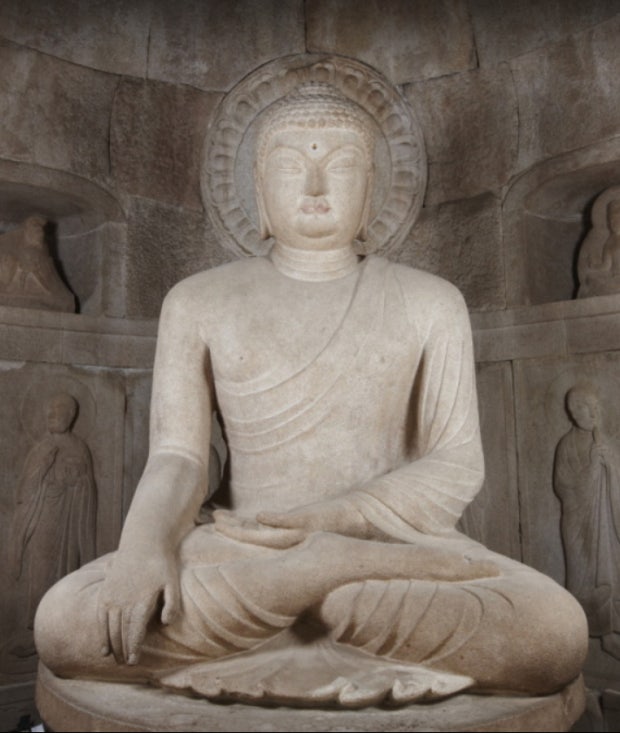
At first glance, visitors may simply see an extraordinary Buddhist sanctuary carved in stone. But behind its serene sculptures lies sophisticated architecture, geometry, and engineering.
Its carefully constructed circular chamber reminds us that the people who created Korea’s ancient masterpieces were not working through artistic intuition alone. Beauty was being built through mathematics, craftsmanship, religious philosophy, and technical knowledge at the same time.
The Sacred Bell of King Seongdeok tells another story.
Famous for its deep and lingering resonance, the bell is admired as much for its engineering as for its beauty. Its inscription also preserves the names of people involved in its creation, including craftsmen.
For Yoo, this detail reveals something important about Silla society: great culture was not created by kings alone. The hands and knowledge of artisans mattered too.