![[Seoul Forum 2026] Before K-Pop, There Was K-Culture #2 > Blog](/img/assets/symbol.svg)
Blog
[Seoul Forum 2026] Before K-Pop, There Was K-Culture #2
Goryeo: Openness, Survival, and Reinvention
The Goryeo Dynasty faced invasions, political upheaval, and the enormous pressure of the Mongol Empire.
Yet it endured for nearly five centuries.
Rather than viewing Goryeo only through the language of submission, Yoo framed its history as one of diplomacy, adaptation, and resilience.
It was also a remarkably cosmopolitan society.
Trade connected Goryeo with merchants from distant regions, and the name by which the country became known abroad eventually gave us the word “Korea.”
Perhaps nowhere is Goryeo’s cultural confidence more visible than in its celadon.
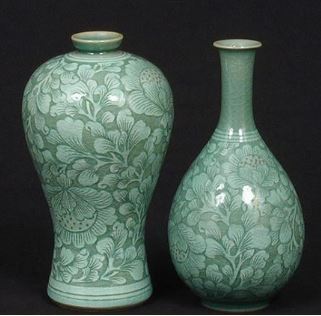
With their distinctive jade-green color and elegant forms, Goryeo celadon ceramics are among Korea’s most celebrated works of art.
Korean artisans also developed the sophisticated sanggam inlay technique, carving designs into the surface and filling them with contrasting materials before glazing.
Rather than merely reproducing outside influences, they transformed ceramic traditions into an aesthetic distinctly their own.
That pattern — encounter, reinterpretation, creation — appears again and again throughout Korean history.
The Beauty of Imperfection
If Goryeo is remembered for the luminous green of celadon, Joseon found beauty in white.
Joseon white porcelain became increasingly restrained and understated, reflecting ideals of scholarship, simplicity, and everyday elegance.
And among its most beloved forms is the moon jar.
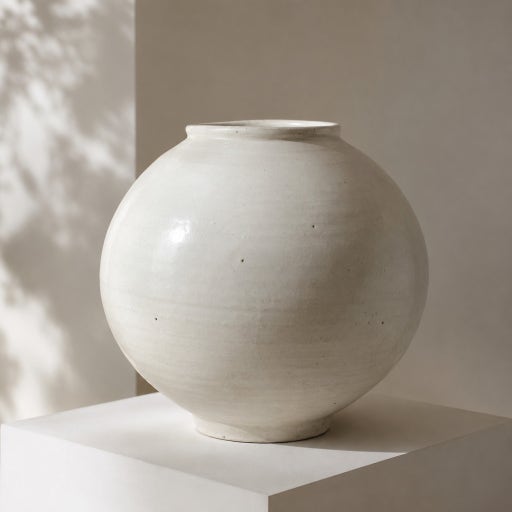
Large, round, and seemingly simple, a moon jar is rarely perfectly symmetrical.
Traditionally, its upper and lower halves were formed separately and then joined together, leaving subtle irregularities in its shape.
Yet those imperfections are precisely what give it warmth.
Rather than pursuing cold geometric perfection, the moon jar allows the traces of the human hand to remain visible.
Yoo connected this quality to a broader understanding of Korean aesthetics — a preference for natural lines, restraint, and forms that invite closeness rather than demand admiration from a distance.
The Japanese thinker Yanagi Soetsu famously interpreted East Asian ceramics through a contrast: Chinese art through form, Japanese art through color, and Korean art through line.
Whether or not such distinctions can capture the full complexity of each tradition, the idea offers an interesting way to look again at Korean objects.
A Korean ceramic piece often feels less like something asking to be displayed and more like something asking to be held.
So, Where Does K-Culture Come From?
K-pop, cinema, television, fashion, food, and design may be the most visible faces of Korea today.
But behind them lies a much longer cultural habit.
For centuries, Korea has encountered influences from beyond its borders, absorbed them, transformed them, and created something recognizably its own.
Silla connected with distant cultures.
Goryeo adapted while navigating powerful neighbors.
Joseon refined an aesthetic in which simplicity and imperfection could become forms of beauty.
Seen this way, the global rise of Korean culture is not an isolated phenomenon.
It is another chapter in a much older story.
As Yoo put it, Korea was never simply a cultural follower. It was a participant — a “cultural shareholder” — in the civilizations around it.
Today, Korea has become one of the world’s most visible cultural exporters.
But perhaps the most interesting way to understand K-culture is not to begin with what Korea is exporting today.
It is to look at what Korea has been creating for centuries.